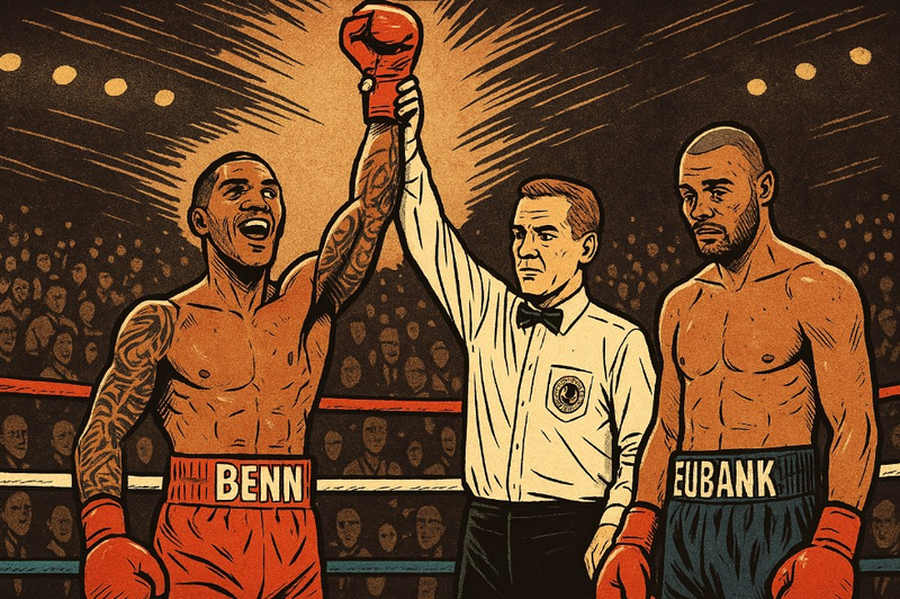
Boxing, often dubbed the “sweet science”, is a sport that captivates audiences worldwide with its blend of raw power, tactical finesse, and sheer athleticism.
While many casual fans may focus solely on the pursuit of a knockout, a significant portion of professional bouts are decided by the judges’ scorecards. Understanding how these matches are scored is crucial for enthusiasts, punters, and aspiring pugilists alike.
I have been betting on boxing for many years, which is why I have written this guide into the intricacies of boxing scoring, exploring the criteria judges use, the point system employed, and the various ways a fight can be decided.
I’ll also examine some controversial decisions that have shaped the sport’s history and discuss the importance of accurate scoring in maintaining the integrity of boxing.
The Fundamentals of Boxing Scoring
At its core, boxing scoring is designed to determine which fighter has been more effective throughout the course of a match. This assessment is made on a round-by-round basis, with judges evaluating various aspects of each boxer’s performance.
The 10-Point Must System
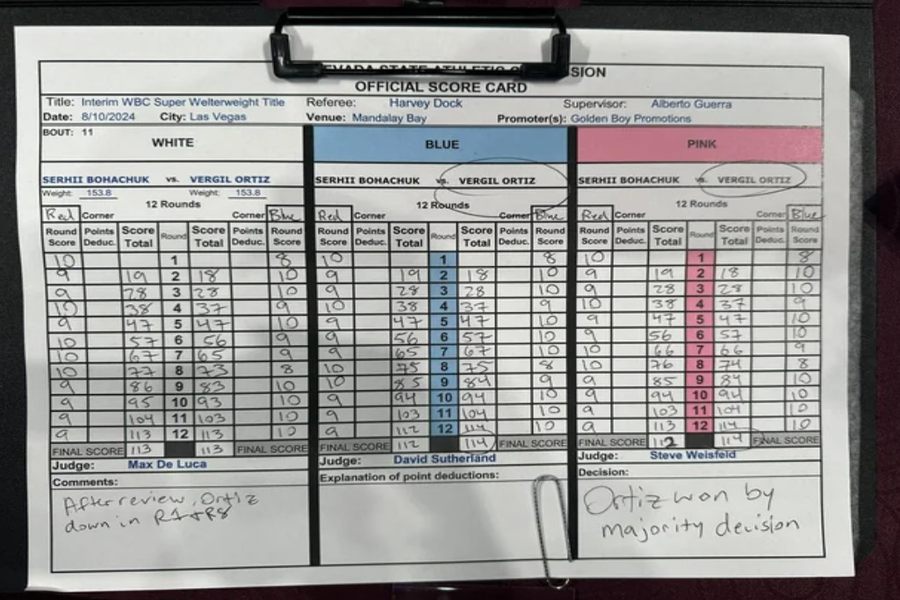
The cornerstone of modern boxing scoring is the 10-Point Must System. This method, which has been the standard in professional boxing since the mid-20th century, requires judges to award 10 points to the winner of each round, with the loser typically receiving 9 points.
Here’s a breakdown of how points are typically allocated:
- 10-9: A close or moderately clear round for one fighter
- 10-8: A dominant round for one fighter, often including a knockdown
- 10-7: An extremely dominant round, usually involving multiple knockdowns
- 10-10: An extremely rare score for a completely even round
It’s worth noting that while 10-10 rounds are technically possible, judges are generally discouraged from using this score to avoid indecisiveness.
Knockdowns and Point Deductions

Knockdowns play a significant role in scoring. When a boxer is knocked down, they automatically lose a point for that round. This means that even if they were winning the round up until that point, a knockdown would likely result in a 10-8 score against them.
However, if both fighters score knockdowns in the same round, these can effectively cancel each other out, potentially resulting in a 10-9 round for the boxer who performed better overall.
Point deductions can also occur due to fouls or rule infractions. The referee has the authority to deduct points for repeated or egregious fouls, which can significantly impact the final scorecards.
Criteria for Scoring a Boxing Match
Judges are tasked with evaluating several key aspects of a boxer’s performance when scoring each round. These criteria help ensure that scoring is as objective as possible, though there will always be an element of subjectivity in the process.
Effective Aggression
One of the primary factors judges consider is effective aggression. This doesn’t simply mean moving forward and throwing punches; rather, it’s about landing clean, impactful blows while pressing the action. A fighter who is constantly advancing but getting countered effectively may not be scored as favourably as one who is more selective but lands cleaner shots.
Ring Generalship
Ring generalship refers to a boxer’s ability to control the pace and location of the fight. This can involve cutting off the ring, forcing an opponent into unfavourable positions, or dictating the tempo of exchanges. A fighter who demonstrates superior ring generalship is often viewed favourably by the judges.
Defence
While offensive output is crucial, judges also pay close attention to a boxer’s defensive skills. This includes the ability to slip punches, block effectively, and avoid clean hits. A fighter with strong defensive abilities can often neutralise an aggressive opponent and score points through counter-punching.
Clean Punching
Perhaps the most straightforward criterion, clean punching refers to the ability to land clear, legal blows on the opponent. Judges look for punches that land flush on the target areas, such as the head or body. It’s important to note that volume alone doesn’t necessarily equate to effective punching; the impact and clarity of the shots are crucial factors.
The Role of Judges

In professional boxing matches, the scoring is typically carried out by three judges positioned around the ring. These individuals are licensed by the relevant boxing commission and are expected to have a deep understanding of the sport and its scoring criteria.
For major bouts, particularly those with international significance, there’s often an emphasis on selecting judges from neutral countries to minimise any potential bias. For example, in a fight between a British and an American boxer, judges might be selected from countries like Canada, Mexico, or Germany.
Judges submit their scorecards at the end of each round. These are collected by officials and tallied at the end of the fight to determine the final result. It’s worth noting that judges do not confer with each other during the bout; each scorecard represents an independent assessment of the fight.
Types of Decisions
When a fight goes the distance without a knockout or stoppage, the judges’ scorecards determine the outcome. There are several possible results based on how the judges score the bout:
- Unanimous Decision – A unanimous decision occurs when all three judges agree on the winner of the fight. This doesn’t necessarily mean that their scorecards are identical, but rather that they all have the same fighter ahead on points.
- Split Decision – In a split decision, two judges score the fight for one boxer, while the third judge scores it for the opponent. This often indicates a close, competitive bout where the winner’s margin of victory was narrow.
- Majority Decision – A majority decision happens when two judges score the fight for one boxer, while the third judge scores it as a draw. The fighter with two winning scorecards is declared the victor.
- Draw – There are two types of draws in boxing: Split Drawn and Unanimous Draw. In a split, one judge scores for Fighter A, another for Fighter B, and the third scores it even. A unanimous draw is when all three judges score the fight as even. Draws are relatively rare in professional boxing but can occur in closely contested bouts.
Outside of KOs and TKOs, the fight will end with one of these decisions.
Controversial Decisions and Their Impact

Throughout boxing history, there have been numerous instances of controversial decisions that have sparked debate and sometimes outrage among fans, fighters, and pundits alike. These contentious outcomes often stem from perceived discrepancies between what observers saw during the fight and how the judges scored it.
Notable Controversial Decisions
One recent example that stirred significant controversy was the split decision victory awarded to Tyson Fury over Francis Ngannou in their 2023 bout. Many observers felt that Ngannou, making his professional boxing debut, had done enough to win the fight, particularly after scoring a knockdown against the more experienced Fury.
Another infamous case is the first fight between Canelo Alvarez and Gennadiy Golovkin in 2017. The bout was declared a draw, but one judge’s wildly divergent scorecard (118-110 in favour of Canelo) drew heavy criticism and scrutiny.
Impact on the Sport
Controversial decisions can have far-reaching consequences for the sport of boxing. They can affect fighters’ careers, potentially costing them title shots or lucrative opportunities. Moreover, repeated controversies can erode fan trust and potentially drive viewers away from the sport.
These incidents often lead to calls for reform in judging practices or scoring systems. Some have advocated for increased transparency, such as real-time scoring updates during fights, while others push for more rigorous training and accountability for judges.
The Importance of Accurate Scoring
Accurate and fair scoring is paramount to maintaining the integrity of boxing. It ensures that fighters are rewarded for their skills and efforts in the ring, and it helps maintain fan engagement and trust in the sport.
For boxers, the outcome of a fight can have significant career implications. A win or loss can affect their ranking, future matchups, and earning potential. In title fights, the stakes are even higher, with championships and legacy on the line.
From a fan perspective, consistent and logical scoring helps maintain interest and investment in the sport. When viewers feel they can trust the judging process, it enhances their enjoyment and understanding of the matches they watch.
For bettors in particular, trusting the judges to get it right is imperative. If you have bet on a fight and it ends in a controversial decision that goes against you, it may dissuade you from betting next time.
Alternative Scoring Methods and Proposed Reforms
While the 10-Point Must System remains the standard in professional boxing, there have been various proposals for alternative scoring methods or reforms to the current system.
Open Scoring
One suggestion that has gained traction in some circles is open scoring, where the judges’ scores are made public after each round. Proponents argue that this increases transparency and allows fighters to adjust their strategies based on the current scorecards.
Half-Point System
Another proposed reform is the half-point scoring system, which would allow judges to score rounds 10-9.5 or 10-8.5, providing more nuance in close rounds. This system has been trialled in some smaller promotions but has not been widely adopted in major boxing organisations.
Potential Technological Innovations
Some have proposed using artificial intelligence or machine learning algorithms to assist in scoring fights. These systems could potentially analyse factors like punch statistics, ring control, and defensive effectiveness to provide a more objective assessment of each round.
While technological advancements offer intriguing possibilities, there’s also a strong desire within the boxing community to maintain the sport’s traditional elements. Finding a balance between innovation and preserving the human element of judging remains a key challenge for the future of boxing scoring.
Conclusion

Understanding how boxing matches are scored is essential for anyone looking to fully appreciate the nuances of the sport. Especially bettors.
From the 10-Point Must System to the criteria judges use to evaluate each round, scoring in boxing is a complex process that requires knowledge, experience, and careful observation.
While controversial decisions will likely always be a part of the sport, ongoing efforts to improve judging practices and increase transparency aim to minimise such occurrences. As boxing continues to evolve, the challenge will be to maintain the integrity of scoring while adapting to new technologies and changing viewer expectations.
Ultimately, accurate and fair scoring is crucial not just for individual fights, but for the long-term health and popularity of boxing as a whole. By understanding the intricacies of how matches are scored, fans can gain a deeper appreciation for the sport and the skills displayed by the athletes in the ring.